Governing
Together
Governing Together responds to one of the greatest challenges of our time: the growing gap between the complexity of the crises we face and the institutional capacity required to navigate them together. We reframe psychosocial conditions and relationality as critical infrastructures that must be deliberately designed, invested in, and continuously strengthened through practice.
Much of the dominant logic shaping public sector innovation and institutional reform still tends to focus on the ‘what’ of change: policies, strategies, technologies, structures and technical solutions. Far less attention is paid to the ‘how’: the cultures, relationships, incentives, power dynamics, behaviours and implementation conditions through which change actually happens.
As a result, technically sound interventions can struggle in practice. Institutions must navigate uncertainty, competing incentives, unintended consequences and relational realities that shape whether meaningful change can emerge, adapt and endure.
Financialised Systems and Fragmented Societies
Over time, the marketisation of public services and the increasing financialisation and fragmentation of many essential systems and services – including housing, healthcare, education, and social care – have often weakened relational and collective capacities while leaving millions of people living in conditions of chronic insecurity, deep wealth inequality, and constant survival.
In many contexts, this has contributed to the erosion of trust, deepened polarisation and social fragmentation, and increasingly hostile forms of everyday politics shaped by resentment, fear, incivility, and processes of othering.
Relationality is the new bottom line.
Relationality and relational intelligence are becoming a new bottom line. In a world shaped by AI, institutional fragility and interconnected crises, the capacity to build relationships, navigate difference, cooperate and repair is increasingly important to how institutions function. Yet these capacities cannot be developed through frameworks, meetings, reports, and presentations alone. They have to be felt and practised.
A policy or technology can be technically excellent and still fail because of the institutional conditions around it. A climate strategy can stall because departments cannot coordinate across administrative silos. An AI system designed to help can start to feel like an overbearing parent if it understands benevolence as simply doing what is ‘best’ for us, without understanding agency, boundaries and context. What works is shaped not only by what we design, but by the relationships and conditions through which it operates, and by how deeply we understand human behaviour and the social and cultural dynamics around it.
Relationality means understanding institutions and societies as systems of interactions and interdependencies, not simply as individual actors or formal structures. Policies, strategies, technologies and governance arrangements matter, but how they work in practice is shaped by trust, power, behaviour, cultural norms, reciprocity, conflict and history.
Across sectors, technologies and cultures, we see that when relational capacity is weak, systems fragment and become reactive. The unintended consequences and downstream social, institutional and economic costs are enormous, yet often remain invisible or unaccounted for. When relational capacity is strong, institutions and communities are better able to cooperate, anticipate consequences, navigate uncertainty, adapt, build legitimacy and sustain change over time.

Ulay / Marina Abramović, Rest Energy, Performance for Video, 4 minutes, ROSC' 80, Dublin, 1980, © Ulay / Marina Abramović, Courtesy of the Marina Abramović Archives
Our Four Leverage Points and Interconnected Areas of Practice
We work across four interconnected areas where designing shifts in governance practice can contribute to wider institutional and societal transformation.
Relational Governance for
Institutional Breakthroughs
We use the concept of ‘institutional breakthroughs’ to describe practical shifts in how institutions govern: how decisions are made, how people work together, how organisations learn, and how power and responsibility are shared. Together, these shifts can strengthen institutions’ capacity to navigate complexity and adapt over time.
Strengthening people's capacity to understand how decisions are made, how power operates and how responsibility is shared, and creating opportunities to learn governance through practice and lived experience.
Surfacing inherited assumptions, power dynamics and dominant narratives that constrain change, while creating space to imagine and practise alternatives.
Designing formal and informal spaces for collective sense-making and decision-making across institutional, cultural and political divides, enabling decisions to be made with, rather than for, others.
Developing ways to recognise and evaluate forms of value that conventional indicators often miss, including lived experience, trust and relational capacity building, and longer-term institutional change.
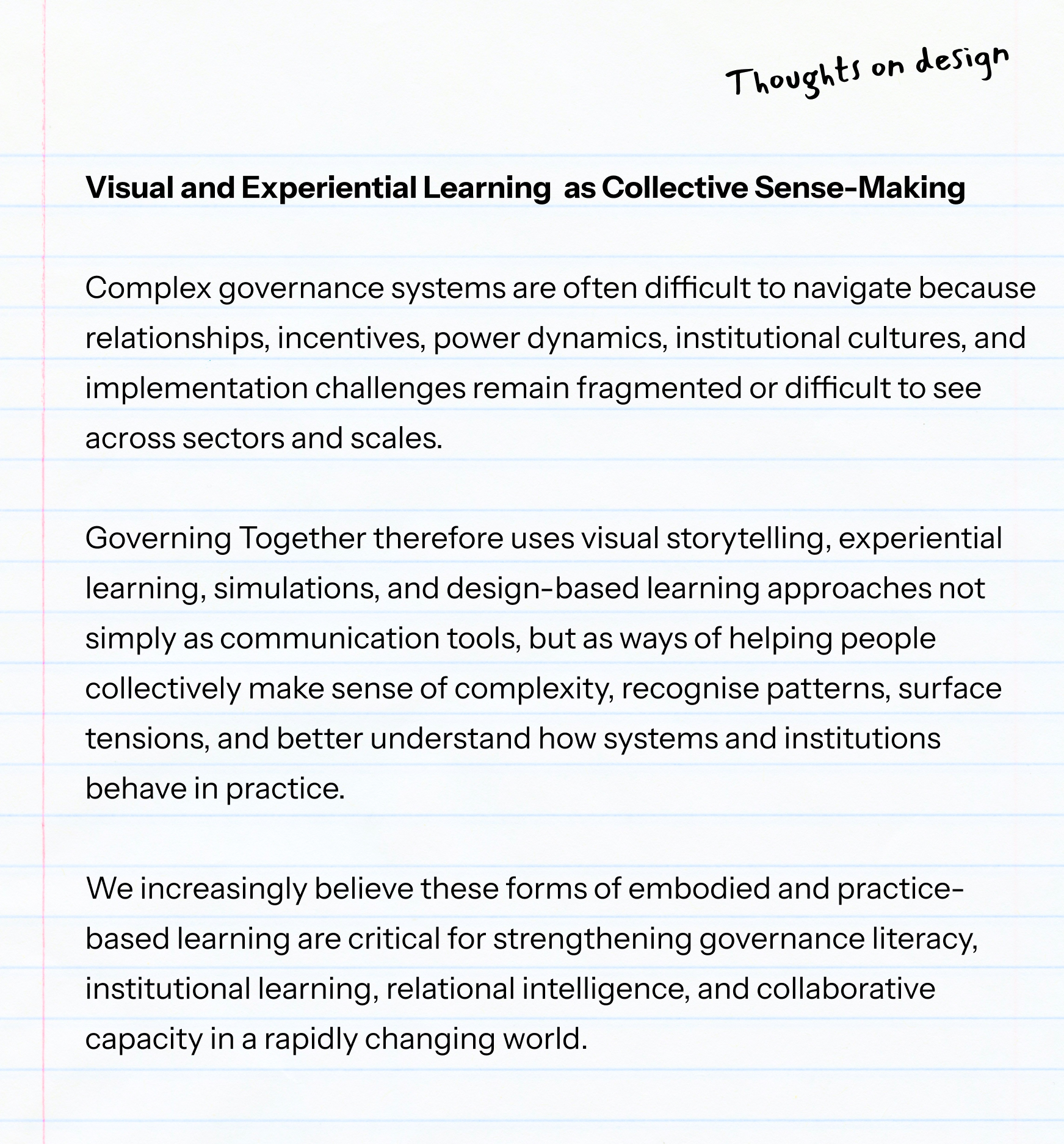

Our multi-level learning and institutional change approach
What kinds of institutional shifts are we trying to enable? Institutional change happens across interacting levels. We therefore connect macro conditions, meso-level experimentation and micro relational dynamics rather than treating them as separate domains.
Macro Level
At the macro level, we examine the wider governance environments, institutional logics and societal paradigms that shape how institutions operate.
Meso Level
At the meso level, we work with institutions and practitioners through real-world use cases that become sites for experimentation and institutional learning.
Micro Level
At the micro level, we develop and test tools and practices that strengthen the relational, psychosocial and trust conditions needed for people to collaborate, learn and exercise collective intelligence.
The Village – Our learning, delivery, and financing infrastructure
Governing Together operates through the ‘Village’: a distributed research-through-design and action-learning ecosystem connecting public and private sector institutions, municipalities, civic organisations, researchers, designers, creative practitioners, funders, technologists and communities.
The Village is not simply a community of practice or knowledge-sharing network. Members work together on real-world governance challenges, developing and testing interventions, demonstrators, learning formats, financing pathways and new implementation practices.
Join the Movement
Did you resonate with our work and want to connect with us?
Register to become a member through our community forum and meet other likeminded people.
Our Current Ecosystem of Partners and Collaborators:
Adam Somlai-Fischer (Prezi, HU)András Bódis (ARSDOMA, HU)Arno Rohwedder (Dark Earth Carbon & Upendo Honey, TZ)Bernadett Szél (Central European University, AUT)Cam Perkins (Darebin City Council, AUS)Dan Lockton (Norwich University, UK)Eszter Bircsák (Independent Strategic Designer, HU)Erurera Tarena (Tokona te Raki: Māori Future Maker, NZ)Fede Vaz (European Commission, BE)Gabrielle Baron (Centre for Public Impact, Global)Gina Hara (Filmmaker, CA)Kata Molnár (WaterLab, HU)Kate Barranco (Conscious Futures, US)Katya Petrikevich (Participation Factory, Czechia)Louise Marix Evans (Quantum Strategy & Technology, UK)Maayan Ashkenazi (Space Relations / Collective Faculties, UK)Michael Peterson (Innovation and Creative Strategist, Educator, Artist and Builder, US)Mihály Rámpay (Semmelweis University / OGYSZ, HU)Mina Naseem Niazi (UNICEF, Pakistan/Italy)Miriam King (LIVING PROOF, UK)Monish Khanderia (Senior Behavioural Scientist, India)Ọghẹnẹmarho (Jude) Robinson (Political and Governance Literacy Advocate, Government Uncle, NG)Phil Korbel (Carbon Literacy Project, UK)Shari Davis (Economic Democracy, US)Stuart O’Reilly (AiR Guiniguada, Spain/Ireland)Tanya Chung-Tiam-Fook (7GenCities, CA)Thomas Marois (Public Banking Project, McMaster University, CA)Tom Perry (The King’s Foundation, UK)Viktor Bedö (Royal College of Art, UK)and many moreEric Hubbard (Urban Biodiversity Hub and NATURA Network Africa Regional Team) – a passionate change-maker and a friend who inspired us tremendously. We remain deeply grateful for everything Eric contributed to the work, and his spirit continues to be part of this community.

Deepening Governance and Civic Literacies
Shifting Entrenched Power Dynamics, Logics, and Master Narratives
Designing New Governance Frameworks, Spaces and Innovation Pathways
Redesigning Standards, Metrics, Accreditations, and Impact Evaluation
Public Sector Innovation and Municipal Transformation
Developing a platform for place-based collaboration and ecological stewardship across a country and its (bio)region.
Embodied and Experiential Learning for Relational and Institutional Capacity-Building
Using digital play-based simulations to build shared understanding, shift mental models, and accelerate institutional change across the globe.
Corporate Social Innovation and Private Sector Stewardship
Partnering with global corporations and brands to embed relational governance in business transformation.
Civic and Governance Literacy
Building immersive, relational learning experiences that make collective decision-making engaging and actionable, and help people reflect on what proactive citizenship means in the twenty-first century.
Relational Finance and Public–Public Collaboration
Shaping financial systems to govern for public value.

Healthy Soil as a Metaphor for Healthy Societies
Governing Together offers a hopeful way of understanding the world, grounded in the continuous enrichment of our human and more-than-human condition. Like healthy soil – which is not a fixed or static thing, but an emergent quality shaped through countless interactions and dynamic flows – our societies, systems, and institutions work in much the same way.
The more nutrients we add to a system, the more likely we are to see healthier outcomes emerge: policies shaped through lived experience; technologies, KPIs, and blueprints that better account for actual human behaviour; governance processes that strengthen trust and cooperation; and designs that take long-term and unintended consequences into account.
Extractive Soil
Unhealthy Societies as depleted Soil
Generative Soil
Healthy Societies as Regenerative Soil


Shifting core values and logics
Growth / Visible Layers
Wealth accumulation alongside deep inequality; concentration of power; division and othering; declining civility; resentment; increasing microaggressions; individualism and isolation; short-termism; ideological rigidity; extraction; instrumentalism; loneliness; distrust; systemic insecurity and risk.
Declining Health Layer
Weakening flows of relationality; eroding trust; increasing polarisation and social fragmentation; and the erosion of 'soft' infrastructures such as trust-building processes, shared and compatible norms, public legitimacy, shared meaning, collective efficacy, and cooperative capacity.
Declining Substrate / Foundational Layer
An absence of integrity, benevolence, conscience, competence, and reciprocity.
Shifting paradigms
Societal/meta layer
Broken or weakened institutions; fragile and under-resourced infrastructures; dysfunctional systems of education, health, and social care; eroding cultural and media ecosystems; ecological degradation; economic instability; declining civic participation and trust.
Organisational layer
Working in silos; ineffective and costly solutions; solving the wrong problems; unhappy teams; high turnover; risk aversion; rigidity; repeating the same patterns; outputs over outcomes; lack of learning and iteration; poor adaptive capacity; weakened collective intelligence.
Interpersonal layer
Low trust; weakened relationships; blame cultures; conflict escalation; poor listening; incivility; decreased loyalty; weakened motivation; transactional dynamics; fragmentation.
Individual layer
Fighting for survival; loneliness; crisis of agency; crisis of imagination; lack of motivation; hopelessness; numbness; feeling paralysed; passive observation; passive citizenship.
Shifting core values and logics
Growth / Visible Layers
Justice and equality; civility; collective intelligence; financial and psychological security; the ability to repair; plurality of worldviews, logics, and experiences; trust; care; loyalty; solidarity; a sense of belonging; stewardship.
Improving Health Layer
Strengthening flows of relationality through deliberate and well-designed processes, practices, and tools ('soft' infrastructures); growing trust; increasing collective intelligence; kindness; psychological safety; stronger social cohesion; increasing cooperative and adaptive capacity.
Strong Substrate / Foundational Layer
A strong foundation rooted in, and continually nurturing, psychosocial conditions such as integrity, benevolence, conscience, competence, and reciprocity; financial and psychological security; dignity.
Shifting paradigms
Societal/meta layer
Resilient and adaptive institutions; appropriately resourced infrastructures; thriving systems of education, health, and social care; nurturing cultural and media ecosystems; ecological preservation and regeneration; economic and financial stability; proactive civic participation; trust-building; public value creation.
Organisational layer
Working collaboratively; high-performing teams; improved collective intelligence; effective solutions and meaningful outcomes; creative and innovative thinking; high retention and loyalty; risk-taking capacity; cognitive flexibility; adaptiveness; learning from patterns and failures.
Interpersonal layer
Trust-building; stronger relationships; confidence; civility; open-mindedness; patience; collective efficacy; creativity; collaborative working; critical thinking; deep listening; safety; freedom to challenge constructively.
Individual layer
Material and structural security; a sense of dignity; secure employment; a regulated nervous system; personal growth; continuous learning; a sense of purpose; self-reflection; kindness; the capacity to think and imagine.
49,000+
impressions across the globe
1–2%
globally of all professional posts on LinkedIn at the time of sharing
Global
reach with readers and feedback from Nigeria, South Africa, Kenya, Pakistan, India, China, Canada, and beyond
Quotes from our readers & partners to our launch publication:
“Really critical work from Governing Together reimagining governance through the lenses of collective action and trust!”
“This is gold! ✦ When scrolling the news feels a bit like watching the apocalypse unfold, proposals for “Designing with and for relationality” from the initiative Governing Together are like hope on the horizon.”
“The Governing Together research nails it: we’ve lost our ability to make sense of the world, and it’s stopping us from making good decisions together… The goal is to create a space where people can genuinely listen to each other’s worldviews and hear what’s really being said.”
“Thought provoking piece on why we need more collective sense making and what that means for governing differently!”
“If you’re someone working in the governance space, or just curious about these larger-than-life systems (especially in the complex world we live in today), this publication is a treasure trove. It transforms abstract concepts of relationality into granular explorations, and expands seemingly straightforward processes into beautiful, complex ecosystems. It really opens your mind to reimagining how governance works and why it fails and could not be more timely.”
“An important discussion about how we can de-centralise decision-making, and share power with communities … in a truly meaningful way.”